
Thoracic Outlet Syndrome Treatment Chalfont
Board-certified Pain Specialists
Thoracic Outlet Syndrome Treatment Chalfont, PA
At PA Pain & Spine Institute, we focus on providing minimally invasive treatment for thoracic outlet syndrome. Our board-certified pain specialists conduct thorough evaluations of each patient's imaging and medical history to accurately diagnose the condition. Based on this assessment, we create a personalized care plan tailored to your specific needs.
Patients typically seek treatment for the thoracic Outlet Syndrome when they experience:
✅ Neck, shoulder, chest wall, upper back, or base-of-skull pain
✅ Arm, hand, or finger numbness, tingling, weakness, or clumsiness
✅ Arm heaviness, fatigue, or worsening symptoms with raised arms, carrying, desk work, or phone use
✅ Night pain or numbness, especially when sleeping with an arm overhead
✅ Swelling, bluish color, enlarged veins, coldness, paleness, or weak pulse in the arm or hand
DIABETIC NEUROPATHY SPECIALISTS
What Causes Spinal Arthritis?
Most spinal arthritis develops gradually as a result of age-related changes in the spine. Additionally, several factors can accelerate the process or increase the severity of symptoms:
Age-related degeneration: Cartilage in the facet joints gradually wears away with normal aging, most commonly beginning in the fourth and fifth decades of life
Mechanical overload: Repetitive bending, twisting, and heavy lifting accelerate facet joint wear over time
Previous spinal injury: Furthermore, prior fractures, dislocations, or surgery can alter spinal mechanics and accelerate arthritis at adjacent levels
Degenerative disc disease: Consequently, as discs lose height, increased mechanical stress transfers to the facet joints and accelerates cartilage breakdown
Obesity: In particular, excess body weight increases mechanical load on the lumbar facet joints, accelerating wear
Genetic factors: Family history of spinal arthritis or degenerative joint disease increases individual risk

Understanding Thoracic Outlet Syndrome
Thoracic outlet syndrome encompasses a group of disorders that result from the compression of nerves or blood vessels located between the collarbone and the first rib. This compression can lead to symptoms such as pain, numbness, and weakness in the shoulder and arm. The condition may be triggered by factors such as poor posture, repetitive overhead activities, or anatomical abnormalities. Symptoms often intensify when the arm is elevated.
The specific structures that are compressed play a crucial role in determining both symptom presentation and the appropriate treatment plan.
There are three types of Thoracic Outlet Syndrome, and identifying the type plays a crucial role in determining the treatment plan:
Neurogenic thoracic outlet syndrome: The condition involves compression of the brachial plexus, making it the most common form of this issue. It results in symptoms such as pain, numbness, tingling, and weakness in the hand. In long-standing cases, there may be noticeable wasting of the small muscles in the hand. Additionally, headaches at the base of the skull are also frequently experienced.
Venous thoracic outlet syndrome: This condition involves compression of the subclavian vein. It typically causes symptoms such as arm swelling, bluish discoloration of the skin, a feeling of heaviness, and prominent surface veins over the shoulder and chest due to increased venous pressure.
Arterial thoracic outlet syndrome: The condition involves compression of the subclavian artery and is the rarest form. It may cause symptoms such as coldness, pallor, weak pulse, or cramping arm pain during overhead activities. This can cause a bulge in the blood vessel, known as an aneurysm, a serious condition that can lead to blood clots.

Research insight:
A 2022 review published in Frontiers in Cardiovascular Medicine by Camporese et al. reports that neurogenic thoracic outlet syndrome accounts for 90-95% of cases, venous thoracic outlet syndrome for 3-5%, and arterial thoracic outlet syndrome for the remaining 1-2%. This distribution is important because the majority of thoracic outlet syndrome cases are nerve-related, the type that tends to respond most effectively to the conservative and interventional care provided in our offices.
Thoracic outlet syndrome is often an overlooked diagnosis in cases of upper limb pain. Many patients arrive after unsuccessful treatments for conditions such as rotator cuff issues or carpal tunnel syndrome. Pinpointing the true source of compression is typically the most vital step in the diagnostic process.
Thoracic Outlet Syndrome Treatment Options

Trigger Point Injections and Myofascial Treatment
TTrigger point injections may lead to relief of the affected muscles and alleviate inflammation, and provide valuable diagnostic insights regarding the true source of the pain.
*This is done outpatient and does not require anesthesia

Image-Guided Nerve Blocks and Diagnostic Injections
An accurately placed nerve block can significantly disrupt the pain cycle, hence may enhance your ability to engage in rehabilitation, and help pinpoint the specific structure responsible for your symptoms; serving both as a diagnostic tool and a source of relief.
*This is done outpatient and mostly does not require anesthesia

Physical Therapy
The primary focus of the therapy program is to open the thoracic outlet rather than to aggressively stretch an already irritated nerve.
Minimally Invasive, Research-Supported Treatments
Our approach follows a gradual progression. We begin with the least invasive options that are strongly supported by medical research. We utilize precisely targeted injections to diagnose the source of your pain and to disrupt the pain cycle. Generally, surgical intervention is reserved exclusively for the small group of patients who genuinely require it.
Trigger Point Injections and Myofascial Treatment
The scalene muscles, pectoralis minor, levator scapulae, and upper trapezius often contain trigger points associated with thoracic outlet syndrome. These trigger points can produce arm pain that resembles nerve compression. Trigger point injections may lead to relief of the affected muscles and alleviate inflammation, and provide valuable diagnostic insights regarding the true source of the pain.
Image-Guided Nerve Blocks and Diagnostic Injections
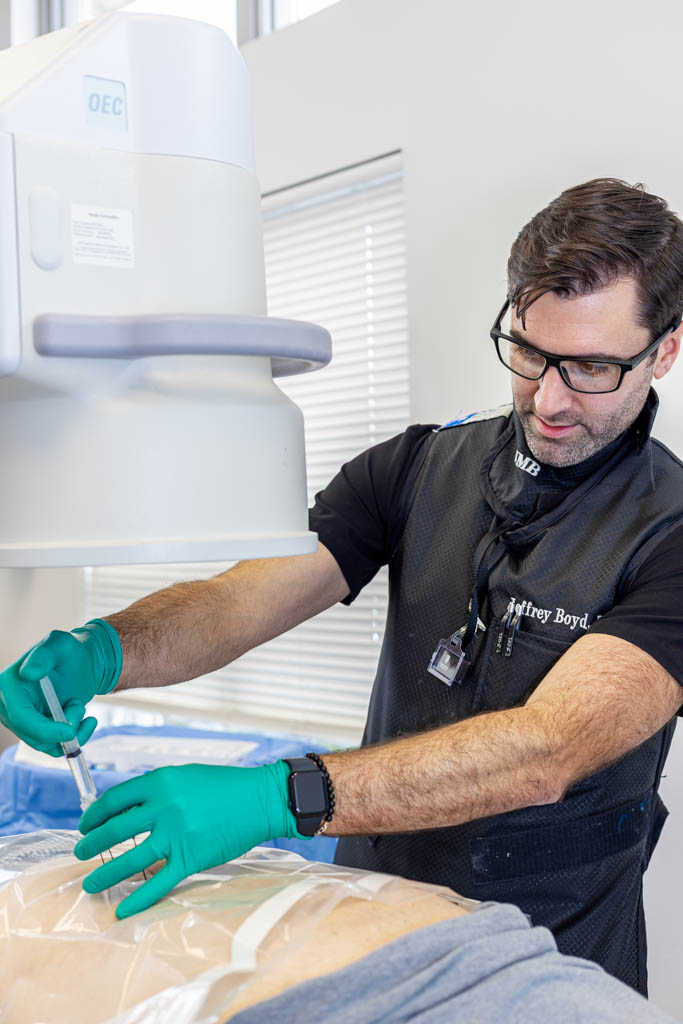
In this procedure, specialists administer nerve blocks using fluoroscopy (live X-ray) or ultrasound guidance to ensure the highest level of precision and safety. An accurately placed nerve block can significantly disrupt the pain cycle, hence may enhance your ability to engage in rehabilitation, and help pinpoint the specific structure responsible for your symptoms. When appropriate in selected cases, a small amount of local anesthetic may be injected into the muscle suspected of causing compression, serving both as a diagnostic tool and a source of relief.
*Outpatient. Does not require general anesthesia.
Physical Therapy
Physical therapy may play a vital role in the recovery process following an injury, particularly in cases of thoracic outlet syndrome. The primary focus of the therapy program is to open the thoracic outlet rather than to aggressively stretch an already irritated nerve. Essential components of this program include scapular stabilization, strengthening of the lower trapezius and serratus muscles, gentle lengthening of the pectoralis minor and scalene muscles, first rib mobilization, breathing retraining, and graded nerve gliding.
Medication and Medical Acupuncture
For short-term symptom management while rehabilitation is underway, healthcare providers may prescribe anti-inflammatory medications, muscle relaxants, and neuropathic pain agents, prioritizing non-opioid options whenever possible. Additionally, medical acupuncture, which uses fine needles to stimulate sensory nerves, may serve as a beneficial adjunct treatment to address the muscular and neuropathic elements of the condition, for some patients who wish to limit their medication intake.
In selected patients with concomitant tendon or soft-tissue injuries in the shoulder girdle, treatments such as platelet-rich plasma (PRP) and orthobiologic injections may provide relief by reducing pain and inflammation. For more information on regenerative therapies, please explore our available resources.
Outpatient. Does not require anesthesia.
Frequently Asked Questions About Spinal Arthritis
How is thoracic outlet syndrome different from a pinched nerve in the neck or carpal tunnel syndrome?
Cervical radiculopathy, carpal tunnel syndrome, and thoracic outlet syndrome can all cause arm pain, numbness, and tingling, often leading to misdiagnosis. Cervical radiculopathy is due to nerve root compression in the spine, carpal tunnel syndrome from median nerve compression at the wrist, and thoracic outlet syndrome from brachial plexus compression. Nerve testing may become crucial when multiple conditions are present simultaneously.
What does thoracic outlet syndrome feel like?
Patients often experience aching or burning sensations in the neck and shoulder, accompanied by numbness or tingling in the arm and hand, especially affecting the ring and little fingers. The arm may feel heavy or become fatigued quickly, with symptoms typically exacerbated when the arm is raised, while carrying a bag, or when sleeping with the arm positioned overhead.
Can thoracic outlet syndrome be treated without surgery?
Neurogenic thoracic outlet syndrome is the most prevalent type, and research indicates that structured physical therapy improves symptoms in approximately 50% to 90% of cases. Surgery is generally reserved for individuals experiencing progressive weakness, muscle wasting, vascular complications, or those who do not respond to conservative treatments.
Why might I need an EMG test?
Electromyography (EMG) and nerve conduction studies help differentiate thoracic outlet syndrome from other conditions, such as carpal tunnel syndrome and cervical radiculopathy. We perform these tests in our office, so there’s no need for additional referrals. However, it’s important to note that normal results can occur in neurogenic thoracic outlet syndrome, and your diagnosis will be based on an interpretation of your comprehensive medical history and examination.
How long does thoracic outlet syndrome take to improve?
Recovery timelines can vary significantly from patient to patient. Some may notice improvements within a few weeks of starting a targeted program, while others may take several months to see changes. Patients who also address underlying posture, workstation setup, or training habits are likely to retain their improvements longer.
What should I expect after an injection?
Downtime is minimal for most patients. Typically, there is only temporary soreness at the injection site lasting one to two days. Patients can usually drive themselves home and resume light activities on the same day. Before proceeding, your physician will review what to expect, including recovery details.
Common Symptoms of Thoracic Outlet Syndrome
- Aching or burning pain in the neck, shoulder, chest wall, or upper back
- Numbness or tingling in the arm, hand, or fingers, often the ring and little fingers
- Weakness, dropping objects, or difficulty with fine tasks such as typing or fastening buttons
- Arm heaviness or rapid fatigue, particularly with the arms raised
- Symptoms that intensify with overhead reaching, carrying bags, or prolonged desk and phone use
- Night pain or numbness that wakes you, especially when sleeping with an arm overhead
- Swelling, bluish color, or visibly enlarged veins in the arm
- Coldness, paleness, or a weak pulse in the hand
- Headaches at the base of the skull
How We Diagnose Thoracic Outlet Syndrome
Physical examination. The diagnosis starts with mapping your symptom pattern, aggravating positions, occupational demands, and prior injuries. Your physician may also examine your posture, shoulder blade mechanics, pulses, and neurologic function.
Provocative positional maneuvers: Through performing arm elevation, shoulder retraction, and head rotation maneuvers, your physician may assess the thoracic outlet for any signs or symptoms. Each of these movements may not provide a clear picture on its own; when considered together and alongside your medical history, they can facilitate a more accurate understanding of the condition.
Electromyography (EMG) and nerve conduction studies. Comprehensive tests may be recommended by your physician in our offices to evaluate nerve and muscle function and to distinguish conditions such as thoracic outlet syndrome from other conditions. By performing the tests onsite, our patients avoid the inconvenience of a separate appointment and the lengthy wait for results.
Imaging. Cervical and chest X-rays can identify a cervical rib or other bony anomalies. MRI helps visualize the compressed segment and rules out cervical spine pathology. Ultrasound with positional maneuvers is utilized when a vascular form is suspected. Your doctor may suggest the most suitable treatment based on your condition.
Diagnostic injections. Some patients experience temporary relief from symptoms after a targeted injection, which offers valuable insights into the underlying cause of their discomfort. This confirmation helps our healthcare providers identify effective treatment options tailored to your specific needs.
Research insight:
“Physical therapy is associated with significant symptom improvement in 50 to 90% of patients… We believe that a structured and standardized rehabilitative process should represent the initial treatment for TOS, leaving surgery only for patients who failed to improve after a conservative management program or with refractory or recurrent symptoms.”
— Camporese G, et al., Frontiers in Cardiovascular Medicine, 2022
Common Causes
- Forward head posture, rounded shoulders, and a dropped shoulder girdle
- Repetitive overhead activity such as swimming, throwing sports, painting, electrical work, hair styling, dental hygiene, assembly work, and music
- Prolonged static desk and phone use
- Heavy shoulder loads such as backpacks, tool bags, and shoulder-carried equipment
- Anatomical variation, including a cervical rib, an elongated C7 transverse process, or a congenital fibrous band
- Trauma includes whiplash injuries, clavicle fractures, and first rib fractures
- Postural changes during pregnancy or weight gain
Why Choose PA Pain & Spine Institute?
Our board-certified, experienced providers focus on finding the source of each patient’s symptoms and matching it with evidence-based care. As with any other condition, our diagnostic-first approach for thoracic outlet syndrome helps identify exactly what is compressed that is causing pain, why symptoms occur, and which treatment is most likely to help. Furthermore, we offer:
- On-site nerve testing: EMG and nerve conduction studies are performed in our offices, eliminating the need for separate referrals and long waits.
- Image-guided precision: Fluoroscopy or ultrasound helps improve injection accuracy and safety.
- Coordinated care: One team manages diagnostics, medication, physical medicine, and interventional treatment.
- Convenient locations: Our offices are located in Chalfont and Quakertown, enabling patients throughout Bucks County to access any of our convenient locations.
Take the Next Step
Chronic pain does not have to mean permanent limitations on movement or escalating dependence on medications. Thoracic outlet syndrome rarely improves on its own while the posture, workload, or anatomy causing it remains unchanged, and long-standing nerve compression becomes harder to reverse over time. If arm pain, numbness, or weakness is interfering with your work, your sleep, or your training, an accurate diagnosis is the fastest route to relief.
Our goal is not just relieving your pain, but working to help restore your maximum ability to move, work, and live well, close to home in Bucks County.
References
- Camporese G, Bernardi E, Venturin A, et al. Diagnostic and therapeutic management of the thoracic outlet syndrome. Review of the literature and report of an Italian experience. Front Cardiovasc Med.
- Dengler NF, Pedro MT, Kretschmer T, Heinen C, Rosahl SK, Antoniadis G. Neurogenic thoracic outlet syndrome: presentation, diagnosis, and treatment. Dtsch Arztebl Int. 2022 Oct 28;119(43):735–742.
- Jones MR, Prabhakar A, Viswanath O, et al. Thoracic outlet syndrome: a comprehensive review of pathophysiology, diagnosis, and treatment. Pain Ther. 2019 Jun;8(1):5–18..
- Illig KA, Donahue D, Duncan A, et al. Reporting standards of the Society for Vascular Surgery for thoracic outlet syndrome. J Vasc Surg. 2016 Sep;64(3):e23–e35.
- PA Pain & Spine Institute. Meet the Providers. pennpain.com/meet-the-providers/.
The information on this page is for general educational purposes only and does not constitute medical advice. Treatment recommendations are based on individual clinical evaluation. Individual results may vary, and no specific outcomes are guaranteed. This content does not create a provider–patient relationship.
Proudly serving Bucks County patients with individualized, evidence-based care focused on improving function, supporting mobility, and helping patients pursue their personal health goals.

