
Cervical Stenosis Treatment in Chalfont,PA
Neck & Arm Pain Specialists in Bucks County
Cervical Stenosis Treatment in PA
When the spinal canal in the neck narrows, the space available for the spinal cord and the nerves that control the arms also reduces, causing cervical stenosis with symptoms such as a stiff or aching neck, tingling or weakness in the arms, and diminished hand function. At the Pennsylvania Pain & Spine Institute, our board-certified physicians specialize in evaluating and treating conditions such as cervical stenosis at our offices in Chalfont and Quakertown. Our approach begins with a comprehensive examination and nerve testing to identify the specific level of the neck that is affected and may include X-ray-guided epidural injections, diagnostic nerve blocks, radiofrequency ablation, and a tailored rehabilitation plan. All procedures are performed in our offices, eliminating the need for a hospital stay.
Patients typically seek medical consultation when they experience:
:
✅ A nagging ache at the base of the neck that intensifies when looking up at a shelf or while reversing out of a driveway.
✅ Recurrent tingling sensations in the thumb, index, or middle finger.
✅ Diminished grip strength or challenges with small tasks, such as securing jewelry or using keys.
✅ Arm pain that disturbs sleep at night or makes it difficult to concentrate during extended periods of desk work.
DIABETIC NEUROPATHY SPECIALISTS
What Causes Spinal Arthritis?
Most spinal arthritis develops gradually as a result of age-related changes in the spine. Additionally, several factors can accelerate the process or increase the severity of symptoms:
Age-related degeneration: Cartilage in the facet joints gradually wears away with normal aging, most commonly beginning in the fourth and fifth decades of life
Mechanical overload: Repetitive bending, twisting, and heavy lifting accelerate facet joint wear over time
Previous spinal injury: Furthermore, prior fractures, dislocations, or surgery can alter spinal mechanics and accelerate arthritis at adjacent levels
Degenerative disc disease: Consequently, as discs lose height, increased mechanical stress transfers to the facet joints and accelerates cartilage breakdown
Obesity: In particular, excess body weight increases mechanical load on the lumbar facet joints, accelerating wear
Genetic factors: Family history of spinal arthritis or degenerative joint disease increases individual risk

Understanding Cervical Stenosis
The seven vertebrae in your neck (C1–C7) stack to form a bony tunnel around the spinal cord. At each level, a pair of nerve roots leaves through side openings called foramina. Stenosis means narrowing. Central stenosis narrows the main tunnel around the cord. Foraminal stenosis narrows the lateral openings through which the nerve roots exit.
Most cervical stenosis is acquired rather than present from birth. A clinical review in StatPearls found that only about 9% of cases are congenital. The rest develop from disc degeneration, thickened ligaments, slipped vertebrae, trauma, or prior spinal surgery (Raja et al., 2023). Stenosis also becomes more common with age. An anatomic study found cervical stenosis in an estimated 4.9% of adults, 6.8% of adults age 50 and older, and 9% of adults age 70 and older (Lee, Cassinelli & Riew, 2007).
Narrowing of the side openings usually causes radiculopathy: pain, tingling, or weakness along one arm. Narrowing of the central canal can compress the cord itself and cause degenerative cervical myelopathy. A systematic review found that 20% to 62% of people with symptomatic myelopathy decline by at least one point on a standard function scale when their condition is not treated with surgery (Tetreault et al., 2017).

Cervical Disc Herniation Treatment Options

Cervical epidural steroid injection
Bathes inflamed nerve roots in the narrowed canal with anti-inflammatory medication, placed under live X-ray
*This is done outpatient and does not require anesthesia
Trigger point injections
Treats secondary muscle knots in the neck and upper back
*This is done outpatient and does not require anesthesia

Diagnostic nerve block
Temporarily numbs one nerve or joint to show whether it is causing the pain
*This is done outpatient and does not require anesthesia
Physical medicine & rehabilitation
Exercise-based program focused on neck endurance, posture and nerve mobility
Spinal cord stimulation
Implanted device that changes how nerve pain signals are processed; tested first with a short trial

Radiofrequency ablation (RFA)
Disrupts the small medial branch nerves that carry arthritic facet-joint pain
*This is done outpatient and does not require anesthesia
Medication management
Anti-inflammatory and nerve-pain medicines, reviewed and adjusted at each visit
Medical acupuncture
Physician-performed needling for chronic neck pain
Minimally Invasive, Research-Supported Treatments
Cervical Epidural Steroid Injections (ESI)
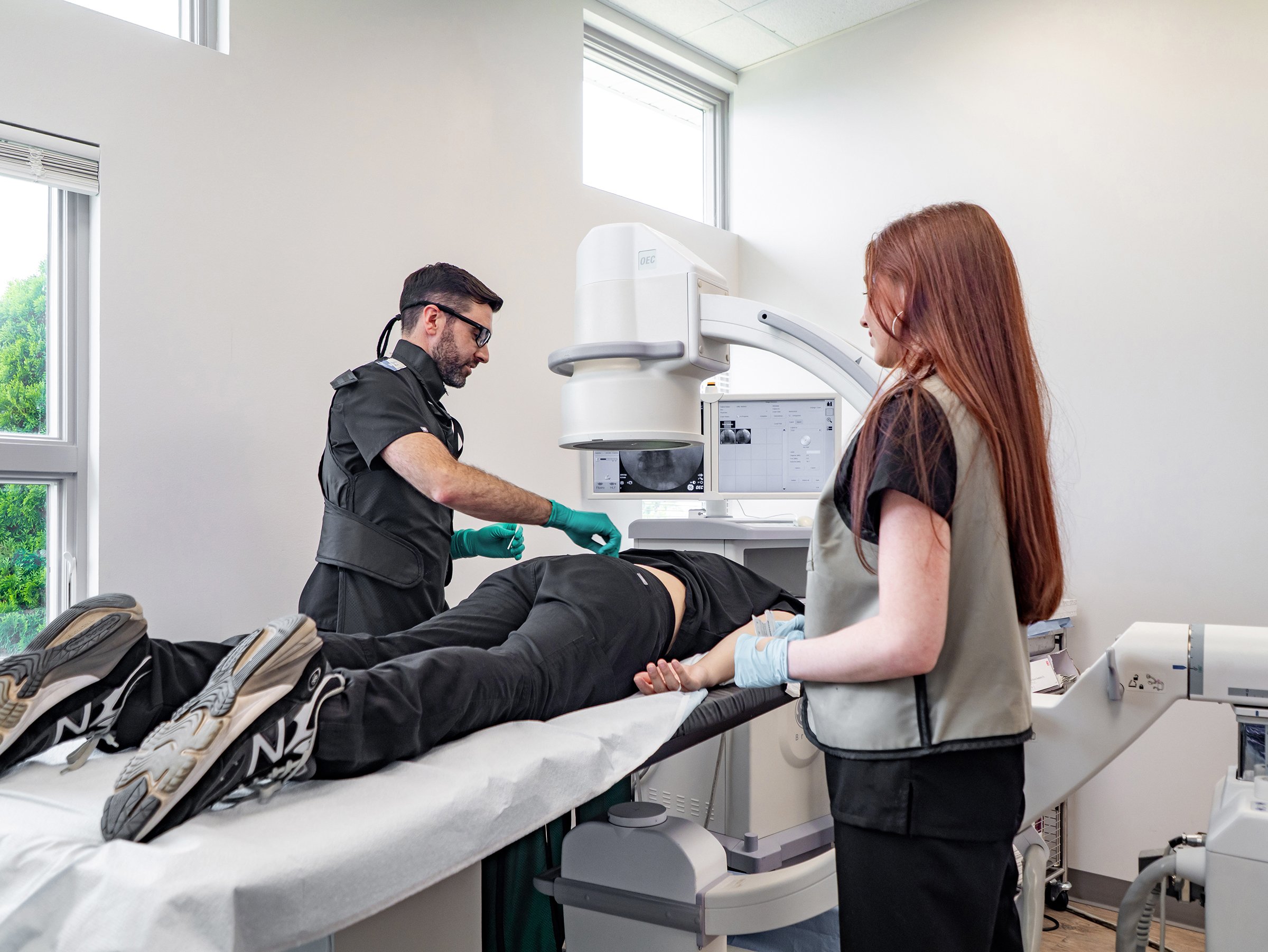
When the spinal canal narrows, nerve roots can become compressed and inflamed, contributing to considerable pain. An epidural steroid injection involves administering a corticosteroid and local anesthetic into the epidural space, an area of fatty tissue just outside the membrane that protects the spinal cord, to target the site of the narrowing. A multidisciplinary safety panel recommends that these injections be guided by live X-ray imaging with contrast dye, a standard our physicians adhere to (Rathmell et al., 2015).
What to expect: A cervical epidural injection usually take 15 to 30 minutes. The anti-inflammatory effect starts within two to seven days, and pain can briefly flare in the first two to three days. Your neck or arm may feel numb or heavy for a few hours after the anesthetic, and most people take it easy for the rest of the day. If you receive sedation, it is best to plan for someone to drive you home.
Nerve Blocks
When stenosis and neck arthritis appear on the same MRI, it can be hard to tell the root cause of the pain. A diagnostic block answers that question. Under X-ray guidance, your physician places a small amount of anesthetic next to one nerve root or next to the medial branch nerves that serve one facet joint. If your usual pain fades within the next few hours, that structure is confirmed as the source of your pain. International consensus guidelines consider medial branch blocks the most reliable means of predicting who will benefit from radiofrequency ablation (Hurley et al., 2021).
Radiofrequency Ablation (RFA)
Facet joints are small, paired joints positioned at the back of each vertebra. Arthritis in these joints commonly occurs alongside cervical stenosis and can result in neck pain as a standalone issue. When nerve blocks confirm the involvement of a facet joint, radiofrequency ablation (RFA) may be utilized. This procedure involves using a heated probe, guided by X-ray imaging, to disrupt the medial branch nerves that transmit pain signals from the affected joint.
A placebo-controlled trial published in The New England Journal of Medicine found that patients treated for neck facet joint pain with RFA experienced significantly longer relief than those who received a sham procedure (Lord et al., 1996). Furthermore, a 2021 international guideline stated that cervical medial branch RFA “may provide benefit to well-selected individuals” (Hurley et al., 2021).
Physical Medicine, Rehabilitation, and Medication Management
Exercise is one of the best-studied treatments for nerve-root symptoms from the neck. At our institute, rehabilitation is centered on strengthening the deep cervical muscles that stabilize the head, optimizing shoulder blade positioning, and incorporating nerve-gliding exercises.
A meta-analysis of 10 randomized trials involving 871 patients found that exercise significantly reduced pain and improved neck function in patients with cervical radiculopathy (Liang et al., 2019). Medications are used alongside rehabilitation and are reviewed at each visit to ensure the dose matches your current symptoms.
Trigger Point Injections
When a nerve is irritated, the muscles around it often tense up and form tender knots, typically in the upper trapezius and levator scapulae. A trigger point injection places an anesthetic directly into a knot to release it. Our Specialists, upon evaluating your condition, may recommend this if it is best for your condition. A 2022 systematic review of 14 studies found that most trigger point techniques relieved chronic myofascial neck and back pain, though no single medication outperformed the others (Debrosse et al., 2022).
Medical Acupuncture
Medical acupuncture has one of the most extensive evidence bases in chronic pain research. At our institute, we use small needles to stimulate sensory nerves, which helps release the body’s natural endorphins. This treatment may be combined with your other therapies, as your provider will determine the best approach during your consultation.
An analysis of individual patient data from 20,827 patients across 39 randomized trials, including those for neck pain, found that acupuncture outperformed both sham acupuncture and usual care. About 85% of the benefit remained 12 months later (Vickers et al., 2018).
Spinal Cord Stimulation for Persistent Nerve Pain
For a small group of patients, nerve pain in the arms and neck can persist even after receiving injections, rehabilitation, or surgery. A spinal cord stimulator is a device that places thin leads in the epidural space of the neck. These leads deliver electrical signals that alter the way the spinal cord transmits pain signals to the brain. A 2024 review reported that cervical spinal cord stimulation improved pain scores and function while reducing the need for prescription pain medication in patients with ongoing neck and arm pain after surgery (Covington et al., 2024). Before a permanent device is considered, every patient completes a temporary trial in our office to see how much it relieves their pain.
Frequently Asked Questions About Spinal Arthritis
What is the difference between cervical stenosis and a herniated disc?
Cervical stenosis refers to reduced space in the spinal canal or nerve openings. A herniated disc is where disc material pushes backward into that space. Stenosis usually builds up slowly from several changes at once, including bone spurs, a thickened ligament and a flattened disc. A herniation can appear suddenly.
Can cervical stenosis be treated without surgery?
Yes, in many cases, especially when the main symptoms are neck or arm pain from nerve roots rather than spinal cord compression. Controlled studies support image-guided epidural injections for cervical stenosis pain, and exercise therapy for nerve-root symptoms. When there are signs of spinal cord compression (myelopathy), international guidelines recommend evaluation by a spine surgeon (Fehlings et al., 2017).
How long does a cervical epidural steroid injection take and when will I feel better?
The procedure itself usually takes 15 to 30 minutes. Because the steroid needs time to calm inflammation, most people notice a change within two to seven days. Your physician reviews your response at a follow-up visit before planning the next step.
Do I need to go to a hospital for cervical stenosis treatment?
No. Diagnostic nerve testing, X-ray-guided epidural injections, nerve blocks and radiofrequency ablation are all performed at our Chalfont and Quakertown offices. You check in, have your procedure and recover in one place.
What are the warning signs that cervical stenosis is pressing on the spinal cord?
Watch for changes in hand dexterity (handwriting getting worse, trouble with buttons or coins), a sense of unsteadiness when walking, numbness in both hands, or leg stiffness. Clinical reviews list clumsiness in the arms and hands, trouble walking and leg weakness as features of spinal cord compression from stenosis. These symptoms need prompt evaluation.
Common Symptoms of Cervical Stenosis
- Neck stiffness and aching, often worse when tilting the head back
- Pain that radiates across the shoulder blade and down one arm
- Pins-and-needles in specific fingers, depending on which nerve root is pinched
- Loss of grip strength or fine hand control
- Headaches that start at the base of the skull
- A heavy or tired feeling in the arms by the end of the day
When to Seek Urgent Care
Get emergency care the same day if you develop sudden weakness in your arms or legs, you can’t walk steadily, you lose control of your bladder or bowels, or your neck symptoms began after a fall or car accident. These can be signs that the spinal cord is under acute pressure.
How We Diagnose Cervical Stenosis
- Symptom mapping: We carefully monitor the sensations in your fingers, noting any instances of tingling, numbness, or discomfort. We also assess which specific movements may lead to pain, as well as any changes in your hand function and gait. By collecting and analyzing this detailed information, we can identify and pinpoint a specific area of concern in your neck that may be contributing to these symptoms.
- Neurological exam: Reflex tests, strength evaluations, the Hoffmann sign, and tandem gait are crucial for distinguishing between nerve root issues and spinal cord problems. These assessments help identify the affected nerves and guide treatment strategies. Your provider may examine you as needed based on your condition.
- MRI review: Magnetic resonance imaging (MRI) is widely regarded as the definitive method for assessing cervical stenosis, a condition characterized by narrowing of the spinal canal in the neck. This advanced imaging technique provides detailed visuals that allow healthcare professionals to evaluate not only the degree of canal narrowing but also any potential changes or damage to the spinal cord itself. If necessary, your provider may request an MRI review.
- In-office EMG and nerve conduction studies: Electromyography (EMG) tests evaluate muscle health and the associated nerve cells. They can help your provider identify nerve damage that is not visible on a physical exam, especially in cases of compression in the neck or wrist, such as carpal tunnel syndrome. This condition often causes similar symptoms, such as pain, tingling, and numbness in the hands. By pinpointing the location and severity of nerve issues, EMG tests help guide effective treatment options for you.
- Diagnostic block: When pain may originate from multiple sources, a targeted nerve block can be an effective diagnostic tool. This procedure involves injecting medication near specific nerves to temporarily alleviate pain and help determine which source is responsible for the discomfort. By identifying the exact origin of the pain, your healthcare provider can make more informed decisions regarding the most appropriate treatment plan to address it effectively.
Research insight:
Dr. Laxmaiah Manchikanti and colleagues conducted a randomized, double-blind trial involving 60 patients with long-term neck pain due to central cervical stenosis, which was published in Pain Physician in 2012. All patients received X-ray-guided cervical epidural injections. Half received only local anesthetic, and the other half received local anesthetic plus a steroid. Neither the patients nor the researchers knew which injection each person received. 73% of the anesthetic-only group and 70% of the steroid group reported significant pain relief. The authors concluded:
“Patients who have chronic function-limiting pain that is secondary to cervical central stenosis might receive relief with cervical interlaminar epidurals of local anesthetic, whether with or without steroids.”
– Manchikanti L, et al. Pain Physician, 2012
Common Causes
Cervical stenosis usually develops from a combination of changes over time:
- Disc degeneration: Discs lose height and bulge backward into the canal
- Bone spurs (osteophytes): Extra bone forms at the edges of worn vertebrae and facet joints
- Ligament thickening: The ligamentum flavum, a ligament behind the spinal cord, can thicken and buckle inward
- Vertebral slippage: One vertebra shifts forward on the one below it
- Congenital narrowing: A naturally small canal, which accounts for a minority of cases
- Prior trauma or spine surgery
Due to the accumulation of several changes over the years, symptoms often develop gradually and may not correspond with the narrow appearance of the canal on imaging.
Why Choose PA Pain & Spine Institute?
Easy, Convenient Care Without the Hospital
Taking care of your neck shouldn’t require a full day in the hospital. At our institute:
- Streamlined care: You’ll receive all of your consultations, EMG testing, image-guided procedures, and follow-up visits from the same physician team. This means your medical records won’t need to be transferred between different facilities.
- Efficient visits: The consultation and necessary procedures can be completed more effectively in our outpatient centers, avoiding multiple visits to hospital outpatient departments.
- No hospital admission: Our procedures are conducted as outpatient treatments, eliminating the need for general anesthesia. This allows you to return home on the same day.
- Convenient locations: We have two offices in Bucks County. Our Chalfont office is open Monday through Thursday, while our Quakertown office is open on Tuesday and Wednesday, from 8:00 AM to 6:00 PM. This makes it convenient for patients across Bucks County.
- Insurance-friendly: We accept most major insurance plans, including Medicare, Independence Blue Cross, AmeriHealth, Highmark, Aetna, UnitedHealthcare, Tricare, UMR, and Workers’ Compensation. Our staff will verify and help with your coverage before your visit.
- High patient satisfaction: Patients who have received treatment from us have reported high satisfaction with the care they received across all our locations. At PA Pain and Spine Institute, we are dedicated to delivering an efficient and comfortable neck care experience tailored to your needs. We have earned an impressive average rating of 4.8 stars based on feedback from over 160 reviews.
Take the next step
Cervical stenosis is more easily treated when detected before any changes occur in nerve or spinal cord function. If you’re experiencing neck pain, arm symptoms, or changes in your hands that affect your daily life, it’s important to seek a specialist evaluation. This can help identify the type of stenosis you have and determine the most appropriate treatment for your condition.
Call 215-395-8888 or request an appointment online at the office nearest you.

References
- Raja A, Patel P, Mesfin FB. Spinal Stenosis. StatPearls. Updated June 12, 2023. https://www.ncbi.nlm.nih.gov/books/NBK441989/
- Lee MJ, Cassinelli EH, Riew KD. Prevalence of cervical spine stenosis: anatomic study in cadavers. J Bone Joint Surg Am. 2007;89(2):376–380. doi:10.2106/JBJS.F.00437. https://doi.org/10.2106/JBJS.F.00437
- Tetreault LA, Karadimas S, Wilson JR, et al. The natural history of degenerative cervical myelopathy and the rate of hospitalization following spinal cord injury: an updated systematic review. Global Spine J. 2017;7(3 Suppl):28S–34S. doi:10.1177/2192568217700396. https://doi.org/10.1177/2192568217700396
- Fehlings MG, Tetreault LA, Riew KD, et al. A clinical practice guideline for the management of patients with degenerative cervical myelopathy. Global Spine J. 2017;7(3 Suppl):70S–83S. https://pmc.ncbi.nlm.nih.gov/articles/PMC5684840/
- Manchikanti L, Malla Y, Cash KA, McManus CD, Pampati V. Fluoroscopic epidural injections in cervical spinal stenosis: preliminary results of a randomized, double-blind, active control trial. Pain Physician. 2012;15(1):E59–E70. PMID: 22270749. https://pubmed.ncbi.nlm.nih.gov/22270749/
- Rathmell JP, Benzon HT, Dreyfuss P, et al. Safeguards to prevent neurologic complications after epidural steroid injections. Anesthesiology. 2015;122(5):974–984. doi:10.1097/ALN.0000000000000614. https://doi.org/10.1097/ALN.0000000000000614
- Hurley RW, Adams MCB, Barad M, et al. Consensus practice guidelines on interventions for cervical spine (facet) joint pain from a multispecialty international working group. Pain Med. 2021;22(11):2443–2524. doi:10.1093/pm/pnab281. https://doi.org/10.1093/pm/pnab281
- Lord SM, Barnsley L, Wallis BJ, McDonald GJ, Bogduk N. Percutaneous radio-frequency neurotomy for chronic cervical zygapophyseal-joint pain. N Engl J Med. 1996;335(23):1721–1726. doi:10.1056/NEJM199612053352302. https://doi.org/10.1056/NEJM199612053352302
- Liang L, Feng M, Cui X, et al. The effect of exercise on cervical radiculopathy: a systematic review and meta-analysis. Medicine (Baltimore). 2019;98(45):e17733. doi:10.1097/MD.0000000000017733. https://doi.org/10.1097/MD.0000000000017733
- Debrosse M, Shergill S, Shah A, et al. Trigger point injection therapies for chronic myofascial neck and back pain: a systematic review. Interv Pain Med. 2022;1(3):100076. doi:10.1016/j.inpm.2022.100076. https://doi.org/10.1016/j.inpm.2022.100076
- Vickers AJ, Vertosick EA, Lewith G, et al. Acupuncture for chronic pain: update of an individual patient data meta-analysis. J Pain. 2018;19(5):455–474. doi:10.1016/j.jpain.2017.11.005. https://doi.org/10.1016/j.jpain.2017.11.005
- Covington S, Strand N, Pew S, et al. Cervical spinal cord stimulation for failed neck surgery syndrome. Curr Pain Headache Rep. 2024;28(7):607–612. doi:10.1007/s11916-024-01214-w. https://doi.org/10.1007/s11916-024-01214-w
The information on this page is for general educational purposes only and does not constitute medical advice. Treatment recommendations are based on individual clinical evaluation. Individual results may vary, and no specific outcomes are guaranteed. This content does not create a provider–patient relationship.
Proudly serving Bucks County patients with individualized, evidence-based care focused on improving function, supporting mobility, and helping patients pursue their personal health goals.

