Cervical Spondylosis Treatment in Chalfont & Quakertown, PA

Neck Arthritis Specialists in Bucks County

Cervical Spondylosis Treatment in Chalfont & Quakertown, PA

At the Pennsylvania Pain & Spine Institute, our team of board-certified pain physicians diagnoses and treats cervical spondylosis, also known as neck arthritis. Patients typically seek medical consultation when they experience:

✅ Persistent or recurring neck pain and stiffness, particularly after periods of activity or prolonged sitting.
✅ Reduced ability to turn or move the neck comfortably, such as when driving or looking over the shoulder.
✅ Pain, numbness, tingling, or other symptoms extending from the neck into the shoulder, arm, or hand.
✅ Neck discomfort that interferes with work, sleep, exercise, or everyday activities.

DIABETIC NEUROPATHY SPECIALISTS

What Causes Spinal Arthritis?

Most spinal arthritis develops gradually as a result of age-related changes in the spine. Additionally, several factors can accelerate the process or increase the severity of symptoms:

Age-related degeneration: Cartilage in the facet joints gradually wears away with normal aging, most commonly beginning in the fourth and fifth decades of life
Mechanical overload: Repetitive bending, twisting, and heavy lifting accelerate facet joint wear over time
Previous spinal injury: Furthermore, prior fractures, dislocations, or surgery can alter spinal mechanics and accelerate arthritis at adjacent levels
Degenerative disc disease: Consequently, as discs lose height, increased mechanical stress transfers to the facet joints and accelerates cartilage breakdown
Obesity: In particular, excess body weight increases mechanical load on the lumbar facet joints, accelerating wear
Genetic factors: Family history of spinal arthritis or degenerative joint disease increases individual risk

pain

What is Cervical Spondylosis?

Over time, the discs and joints in your neck wear down. The discs lose height, the joints develop arthritis, and bone spurs can form. For many people that means a stiff, achy neck. If the changes crowd a nerve, you can feel it in your shoulder, arm, or hand.

We start with your symptoms, your history, and your imaging, then work out whether spondylosis is actually behind your pain. Plenty of people have wear and tear on an X-ray without any pain, so the scan alone doesn’t decide it.


Research insight:

“Cervical spondylosis is generally classified according to these three clinical syndromes or means of presentation: axial neck pain, cervical radiculopathy, and cervical myelopathy.”

– Kelly et al., 2012, Advances in Orthopedics

Cervical Spondylosis Treatment Options

Cervical facet point injections


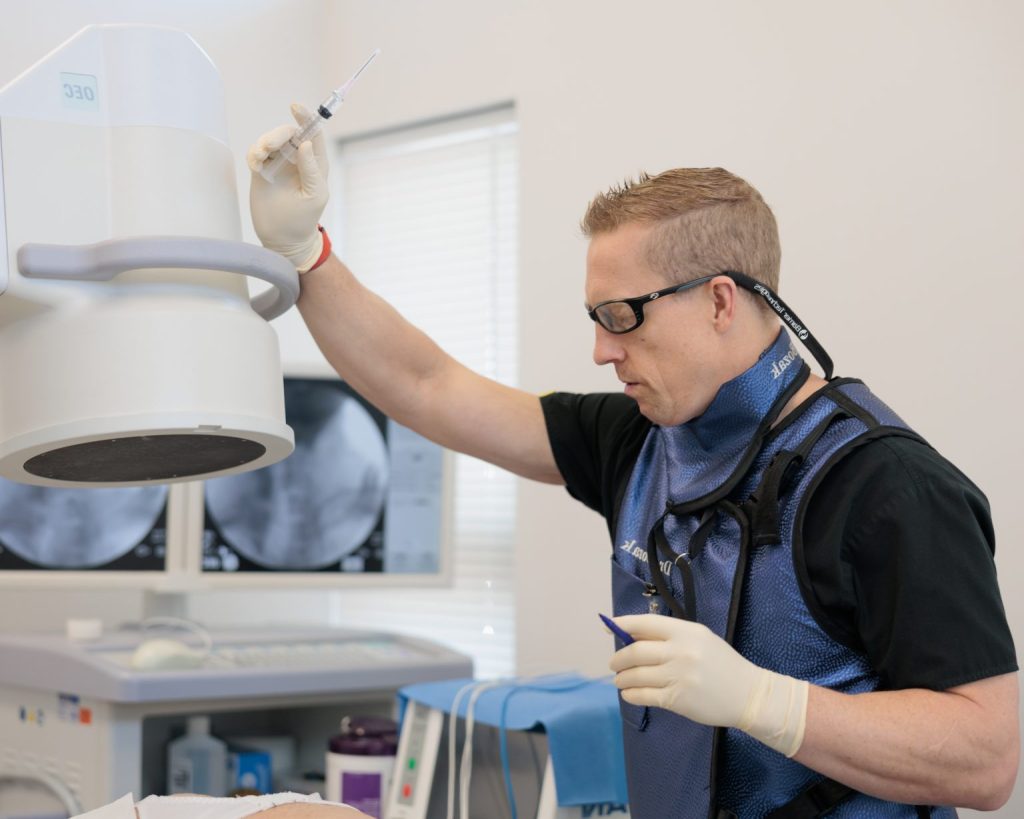
The facet joints are small joints located along the back of the cervical spine. Arthritis in these joints can contribute to localized neck pain and pain that extends toward the shoulders. When facet joint pain is suspected, a targeted injection may be used to place medication near the affected joint. These procedures are performed using imaging guidance to help with accurate placement.

*This is done outpatient and does not require anesthesia

Cervical epidural steroid injections


Cervical spondylosis can sometimes contribute to narrowing around a nerve root. When a cervical nerve is irritated or compressed, symptoms may extend from the neck into the shoulder, arm, or hand. A cervical epidural steroid injection places anti-inflammatory medication into the epidural space near the affected nerve. These injections may be considered when symptoms and clinical findings are consistent with cervical radiculopathy.

*This is done outpatient and does not require anesthesia

Medial branch nerve block


Small nerves called medial branch nerves carry pain signals from the facet joints. A medial branch block places a local anesthetic near these nerves. In addition to potentially providing temporary symptom relief, a medial branch block may help determine whether the cervical facet joints are contributing to the patient's pain. The results can help guide subsequent treatment decisions.

*This is done outpatient and does not require anesthesia

Radiofrequency ablation


For some patients with cervical facet-related pain, radiofrequency ablation may be considered after diagnostic medial branch blocks indicate that the facet joints are a likely source of symptoms. During the procedure, radiofrequency energy is used to interrupt pain signaling along targeted nerves. Whether this treatment is appropriate depends on the patient's diagnosis, symptoms, and response to diagnostic blocks.

*This is done outpatient and does not require anesthesia
Research insight:

“Cervical spondylosis is generally classified according to these three clinical syndromes or means of presentation: axial neck pain, cervical radiculopathy, and cervical myelopathy.”

– Kelly et al., 2012, Advances in Orthopedics

Frequently Asked Questions About Cervical Spondylosis

What is the difference between cervical spondylosis and cervical radiculopathy?

Cervical spondylosis and cervical radiculopathy are related but are not the same condition.

Cervical spondylosis refers to degenerative changes in the cervical spine, including changes involving the discs and facet joints.

Cervical radiculopathy occurs when a nerve root in the neck becomes irritated or compressed, potentially causing pain, numbness, tingling, or weakness that travels into the arm or hand.

A person can have cervical spondylosis without cervical radiculopathy. In other cases, degenerative changes associated with cervical spondylosis can contribute to nerve compression

Cervical spondylosis is commonly associated with changes that occur in the spine over time. Factors that may contribute include:

  • Age-related changes in the spinal discs and joints
  • Disc degeneration
  • Changes in the cervical facet joints
  • Bone spur formation
  • Previous neck injuries
  • Repetitive stress on the neck

The presence of these changes on an X-ray or MRI does not necessarily mean they are the source of someone’s symptoms. A clinical evaluation helps determine whether the findings correspond with the patient’s pain pattern and physical examination.

When should I see a pain specialist for cervical spondylosis?

Neck stiffness or occasional neck discomfort may improve with conservative care. However, persistent neck pain or symptoms extending into the arm or hand may warrant a medical evaluation.

You should discuss your symptoms with a healthcare provider if you experience:

  • Persistent or worsening neck pain
  • Pain that travels from the neck into the shoulder or arm
  • Numbness or tingling in an arm or hand
  • Weakness in the arm or hand
  • Reduced neck mobility that interferes with daily activities
  • Symptoms that persist despite conservative treatment

New or worsening weakness, significant loss of coordination, or other concerning neurological symptoms should be evaluated promptly.

Common Symptoms of Cervical Spondylosis

Symptoms of cervical spondylosis can vary depending on the structures involved. Common symptoms may include:

  • Neck pain or aching
  • Neck stiffness, particularly after periods of inactivity
  • Reduced ability to turn or move the neck
  • Pain that extends into the shoulders or upper back
  • Headaches that may be associated with neck pain
  • Numbness or tingling in the shoulder, arm, or hand
  • Weakness in an arm or hand when a nerve is affected
  • How We Diagnose Cervical Spondylosis

  • Diagnosis begins with a medical history and physical examination. Your provider may evaluate your neck’s range of motion, strength, reflexes, sensation, and the distribution of your symptoms.Imaging may also be used when appropriate. X-rays can show changes such as reduced disc space, arthritis in the facet joints, or bone spurs. MRI can provide additional information about discs, nerves, and other soft tissues.Imaging findings are considered alongside your symptoms and examination rather than used on their own to determine the source of pain.

  •  
  • Cervical Spondylosis Treatment in Chalfont and Quakertown

    At PA Pain & Spine Institute, our board-certified pain specialists provide evaluation and treatment for neck pain, cervical spondylosis, cervical facet pain, and related spinal conditions.

    Treatment is based on an individual’s symptoms, examination, imaging, and clinical diagnosis. Depending on the source of the symptoms, care may include rehabilitation, targeted injections, diagnostic nerve blocks, or other minimally invasive treatment options.

    Our offices serve patients in Chalfont and Quakertown, PA.

    .

Take the Next Step

If neck arthritis or cervical spondylosis is affecting your daily activities, a clinical evaluation can help determine whether the condition is contributing to your symptoms and what treatment options may be appropriate.

Schedule an appointment with PA Pain & Spine Institute to discuss your neck pain and explore treatment options with a board-certified pain specialist.

Research insight:

“Disc degeneration and development of spondylosis are part of the normal aging process.”
– Takagi et al., 2011, Disease-a-Month


References

  • Kelly JC, Groarke PJ, Butler JS, Poynton AR, O’Byrne JM. The natural history and clinical syndromes of degenerative cervical spondylosis. Adv Orthop. 2012;2012:393642. PMID: 22162812.
  • Rao RD, Currier BL, Albert TJ, et al. Degenerative cervical spondylosis: clinical syndromes, pathogenesis, and management. J Bone Joint Surg Am. 2007;89(6):1360-1378. PMID: 17575617.
  • Takagi I, Eliyas JK, Stadlan N. Cervical spondylosis: an update on pathophysiology, clinical manifestation, and management strategies. Dis Mon. 2011;57(10):583-591
  • Voorhies RM. Cervical spondylosis: recognition, differential diagnosis, and management. Ochsner J. 2001.

The information on this page is for general educational purposes only and does not constitute medical advice. Treatment recommendations are based on individual clinical evaluation. Individual results may vary, and no specific outcomes are guaranteed. This content does not create a provider–patient relationship.

Proudly serving Bucks County patients with individualized, evidence-based care focused on improving function, supporting mobility, and helping patients pursue their personal health goals.

Call Now Call Now Email Us Email Us