
Carpal Tunnel Syndrome Treatment in Quakertown, PA
CARPAL TUNNEL SYNDROME SPECIALISTS IN BUCKS COUNTY
Carpal Tunnel Syndrome Treatment in Quakertown, PA
Carpal tunnel syndrome (CTS) is a condition characterized by numbness, tingling, burning sensations, or pain in the thumb, index finger, middle finger, and part of the ring finger. This occurs when the median nerve, which provides sensation to these areas, becomes compressed as it passes through the carpal tunnel, a narrow passageway in the wrist. The increased pressure within the tunnel can lead to varying symptoms. These often start gradually and may come and go, but if the pressure persists, it can result in weakness, clumsiness, and even the dropping of objects. Early evaluation is important for diagnosing CTS, as it allows for treatment before significant nerve damage occurs.
Patients often consult PA Pain & Spine Institute when hand numbness or tingling begins to interfere with sleep, work, or everyday tasks. Common concerns include:
✅ Numbness, tingling, or “pins and needles” in the thumb, index, middle, and ring fingers
✅ Hand pain or tingling that wakes you up at night and improves when you shake out your hand
✅ Weakness, clumsiness, or trouble gripping, buttoning clothes, or holding a phone
✅ Pain or burning that travels from the wrist into the palm or up the forearm
DIABETIC NEUROPATHY SPECIALISTS
What Causes Spinal Arthritis?
Most spinal arthritis develops gradually as a result of age-related changes in the spine. Additionally, several factors can accelerate the process or increase the severity of symptoms:
Age-related degeneration: Cartilage in the facet joints gradually wears away with normal aging, most commonly beginning in the fourth and fifth decades of life
Mechanical overload: Repetitive bending, twisting, and heavy lifting accelerate facet joint wear over time
Previous spinal injury: Furthermore, prior fractures, dislocations, or surgery can alter spinal mechanics and accelerate arthritis at adjacent levels
Degenerative disc disease: Consequently, as discs lose height, increased mechanical stress transfers to the facet joints and accelerates cartilage breakdown
Obesity: In particular, excess body weight increases mechanical load on the lumbar facet joints, accelerating wear
Genetic factors: Family history of spinal arthritis or degenerative joint disease increases individual risk

What Causes Carpal Tunnel Syndrome?
The carpal tunnel is a narrow passageway in the wrist, created by the small bones on the bottom and sides and covered by a strong band of tissue known as the transverse carpal ligament on top. According to the American Academy of Orthopaedic Surgeons (AAOS), this ligament is highly rigid and does not stretch much. Within the tunnel, both the median nerve and nine tendons that control the bending of the fingers and thumb are located. Any condition that narrows the tunnel or causes the tendons to swell can increase pressure on the median nerve.
In most people, carpal tunnel syndrome results from a combination of factors rather than a single cause. Some people are born with a smaller carpal tunnel. Repetitive hand and wrist motions, prolonged wrist bending, and forceful gripping can irritate the tendons and increase pressure. Health conditions such as diabetes, rheumatoid arthritis, and thyroid imbalance may also contribute to carpal tunnel syndrome. Women and older adults are more likely to develop it

Carpal Tunnel Syndrome Treatment Options

Image-guided carpal tunnel injection
Image-guided carpal tunnel injection
Corticosteroid and numbing medication placed into the carpal tunnel using ultrasound guidance.
*This is done outpatient and does not require anesthesia

Platelet-rich plasma (PRP) therapy
Concentrated platelet solution, prepared from the patient’s own blood, is injected into the affected area to promote healing while minimizing reliance on steroids.
*This is done outpatient and does not require anesthesia

EMG / nerve conduction test
To confirm the presence of median nerve compression, assess its severity, and rule out a pinched nerve in the neck, a combination of physical examinations, electrodiagnostic tests, and imaging studies is performed in an in-office setting.
*This is done outpatient and does not require anesthesia
Minimally Invasive, Research-Supported Treatments
Image-Guided Carpal Tunnel Injections
When there is a painful swelling around the median nerve, your physician may recommend an injection that combines a corticosteroid with a numbing agent. This treatment aims to reduce inflammation within the tunnel, ease pressure on the nerve, and relieve numbness, tingling, and nighttime pain.
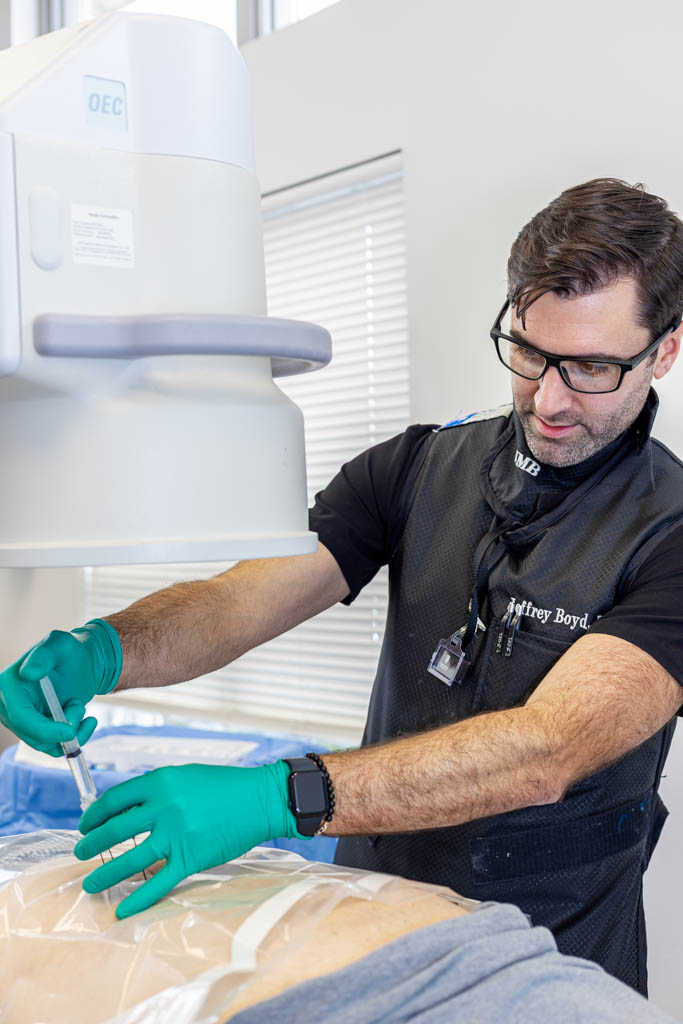
As the median nerve lies just beneath the skin in a very small space, our physicians use ultrasound guidance to visualize the nerve and tendons in real time and to place the medication precisely.
These injections are most helpful for mild to moderate symptoms and for calming a flare-up. The AAOS notes that relief is often temporary, so the provider generally pairs the injection with bracing and activity changes and tracks progress over time.
What to expect: First, the physician will numb the skin at the wrist, then use ultrasound to guide a thin needle into the carpal tunnel without touching the median nerve. You may drive yourself home after this visit. Your provider can suggest wearing your wrist brace and going easy on gripping and repetitive hand tasks for a few days.
*Done in the office with local numbing only. No sedation or hospital stay.
Platelet-Rich Plasma (PRP) Therapy
In this regenerative approach, physicians draw a small amount of blood from patients and centrifuge it to separate platelets. Platelets are rich in growth factors that help with tissue repair. Using ultrasound to see the median nerve inside the carpal tunnel, your physician then places the platelet concentrate around the nerve, where swelling and irritation are causing the numbness.
PRP may be considered for patients with mild to moderate carpal tunnel syndrome who have not improved enough with bracing and medication, or who prefer to limit repeated steroid injections.
A 2022 network meta-analysis of randomized trials found PRP improved symptoms and hand function over follow-up periods of up to 12 weeks. However, the 2024 AAOS clinical practice guideline found that PRP does not provide long-term benefit, so your provider will review your nerve testing results and goals before recommending it.
*Your own blood is collected, prepared, and injected during one outpatient visit. No incisions or stitches are needed.
EMG and Nerve Conduction Testing
An EMG and nerve conduction test measures how well the median nerve conducts signals across the wrist and assesses the health of the muscles it innervates. Testing helps confirm carpal tunnel syndrome, shows whether compression is mild, moderate, or severe, and can identify other causes of hand numbness, such as a pinched nerve in the neck, ulnar nerve compression at the elbow, or peripheral neuropathy. These results further guide the decision on the next steps.
What to expect: This test is performed in our office, with efficient scheduling and turnaround on results, so you do not need a separate appointment.
Physical Medicine, Rehabilitation, and Medication Management
Our board-certified physical medicine and rehabilitation (PM&R) physicians tailor a plan to facilitate your daily activities. According to the AAOS, wearing a wrist brace or splint at night keeps the wrist from bending during sleep and reduces pressure on the nerve. Your plan may also include nerve gliding exercises that help the median nerve move more freely, along with practical changes to typing posture, tool grip, and workstation setup. When appropriate, your provider may coordinate with hand or physical therapists so your in-office treatment and home program work together.
Medication management can make nights and workdays easier for patients while other ongoing treatments take effect. Depending on the symptoms, current medications, and health history, your provider may recommend anti-inflammatory, non-opioid medications to calm swelling in the tunnel, or a nerve pain medication to help you ease the burning and tingling sensation.
Frequently Asked Questions About Carpal Tunnel Syndrome
Can carpal tunnel syndrome go away without surgery?
When treated early, mild carpal tunnel syndrome often improves with nonsurgical care. According to the American Academy of Orthopaedic Surgeons (AAOS), night splinting, activity changes, anti-inflammatory medication, and corticosteroid injections can relieve symptoms, although injection relief can often be temporary. If nerve testing shows severe compression, or if numbness becomes constant or thumb muscles weaken, surgical evaluation is generally recommended to prevent permanent nerve damage.
Do steroid injections work for carpal tunnel syndrome?
Steroid injections can reduce symptoms in the short term. According to a randomized, placebo-controlled trial published in the Annals of Internal Medicine, patients who received a methylprednisolone injection had greater symptom improvement at 10 weeks than those who received a placebo. At one year, 73% of patients in the higher-dose group had undergone surgery, compared with 92% in the placebo group, indicating that injections help some patients delay or avoid surgery, while others still need it.
What does carpal tunnel syndrome feel like?
Most people feel numbness, tingling, or burning in the thumb, index, middle, and ring fingers. Symptoms often wake people at night and improve after shaking the hand. Over time, some people notice weakness, clumsiness, or a tendency to drop objects.
What is the difference between carpal tunnel syndrome and a pinched nerve in the neck?
Carpal tunnel syndrome results from the compression of the median nerve at the wrist, whereas cervical radiculopathy occurs when a nerve root is pinched as it leaves the spine. Both conditions can lead to symptoms like hand numbness and tingling, and some individuals may experience both simultaneously. That is why tests such as electromyography (EMG) and nerve conduction studies can be used to accurately identify the site of nerve compression.
How long does recovery from carpal tunnel syndrome take?
Recovery depends on how long you have had symptoms and how much the nerve has been affected. Many patients with mild symptoms start to feel better within weeks after beginning bracing and changing their activities. If surgery is necessary, the American Academy of Orthopaedic Surgeons (AAOS) says that nighttime symptoms often improve within the first week. Grip strength usually returns in about 2 to 3 months, and full recovery may take up to a year.
Common Symptoms of Carpal Tunnel Syndrome
- Numbness or tingling in the thumb, index, middle, and ring fingers
- Hand pain or tingling that wakes you up at night
- Burning or shock-like sensations in the fingers
- Pain that travels from the wrist up into the forearm
- Weak grip, clumsiness, or dropping objects
- Shrinking of the muscles at the base of the thumb in advanced cases.
When to Seek Urgent Care
Seek prompt medical attention if numbness in your hand becomes constant, if you notice the muscles at the base of your thumb shrinking, or if your hand becomes so weak that you have difficulty gripping objects. Also, seek care right away if you experience sudden weakness or numbness on one side of your body, facial drooping, or trouble speaking, as these symptoms may indicate a stroke rather than a wrist problem.
How We Diagnose Carpal Tunnel Syndrome
- Physical Examination: Your healthcare provider will assess your symptoms, work activities, hobbies, and medical history. They will perform several tests, including tapping over the median nerve (known as Tinel’s sign), positioning your wrist in a bent position (called Phalen’s test), checking the sensation in each finger, and evaluating the strength and size of your thumb muscles.
- EMG / Nerve Conduction Testing: Physicians may perform an in-office EMG test to assess how well the median nerve transmits signals across the wrist. Furthermore, it confirms the diagnosis, helps grade the severity, and identifies if there is a pinched nerve in the neck or a more widespread neuropathy.
- Musculoskeletal Ultrasound: This in-office imaging technique diagnoses various conditions by providing a real-time view of the median nerve and surrounding tendons. It can also detect nerve swelling or compression and help your physician accurately guide injections.
- X-ray: X-rays are used to check for arthritis, prior fractures, or other changes in the wrist that may narrow the carpal tunnel, which helps guide treatment plans for patients.
- Lab Work Review: When appropriate, your provider may review blood work for diabetes or thyroid problems, which can possibly contribute to nerve compression.
Research Insight
“Platelet Rich Plasma is a safe modality that effectively relieves pain and improves disability.”
– Wu YT, et al. Scientific Reports, 2017
In this trial, 60 patients with mild to moderate carpal tunnel syndrome received either one ultrasound-guided PRP injection or a night splint. At six months, the PRP group had less pain and better hand function, and imaging showed less swelling of the median nerve.
Common Causes
Intermittent numbness can be an early warning from your nerves. Addressing carpal tunnel syndrome at this stage offers the best chance to protect the feeling and strength in your hand. Our team will identify the underlying cause of your symptoms, guide you through the various in-office treatment options, and tailor your plan as you improve.
Carpal tunnel syndrome is common. A population study published in JAMA found that 14.4% of adults reported numbness or tingling in the median nerve area of the hand, and 3.8% had clinically certain carpal tunnel syndrome. Because numbness in the hand can also come from a pinched nerve in the neck or from peripheral neuropathy, a careful exam and nerve testing help confirm the true source of symptoms.
The carpal tunnel risk factors we evaluate most often include:
- Repetitive hand use: Typing, assembly-line work, tool use, hairdressing, and other jobs that involve repeated gripping or wrist bending
- Diabetes and neuropathy: Diabetes increases the risk of nerve compression, and many patients have both carpal tunnel syndrome and diabetic neuropathy
- Arthritis and wrist injury: Rheumatoid arthritis, wrist arthritis, or a prior fracture can narrow the tunnel or inflame the surrounding tissue
- Pregnancy and hormonal changes: Fluid retention during pregnancy or menopause can increase pressure inside the carpal tunnel
Why Choose PA Pain & Spine Institute?
Easy, Convenient Care Without the Hospital
Many people with carpal tunnel syndrome often find themselves shuffled between different offices: one appointment for an examination, another for nerve testing at a hospital, and a third for treatment. At PA Pain & Spine Institute, located in Chalfont and Quakertown, we streamline these steps in one place. Your physician will examine your hand, perform the EMG and nerve conduction studies, discuss the results with you, and, when appropriate, provide an ultrasound-guided injection – all in an in-office setting.
- Experienced, Board-certified physicians: Our care is delivered by a team of highly skilled, board-certified physicians: Dr. Robert Kelly, Dr. David Bozak, and Dr. Jeffrey Boyd. Each physician has extensive training in pain medicine and valuable experience to provide you with the best possible care.
- Testing and treatment under one roof: In-office EMG and nerve conduction studies confirm the diagnosis and severity, so your treatment plan is based on objective results rather than symptoms alone.
- Coordinated care from diagnosis through recovery: Evaluation, testing, in-office procedures, and rehabilitation guidance occur within a single, connected care pathway.
- Convenient access and office hours: We offer care in Chalfont and Quakertown and accept most major insurance plans, including Medicare. Chalfont is open Monday-Thursday, 8:00 am-6:00 pm; Quakertown is open Tuesday and Wednesday, 8:00 am-6:00 pm.
- Trusted by patients: PA Pain & Spine Institute has a 4.8-star rating from over 160 satisfied patients.
Take the Next Step
Carpal tunnel syndrome doesn’t have to result in sleepless nights, dropped objects, or time off work. Don’t let hand numbness, tingling, or nerve pain disrupt your work or daily life. Schedule a consultation to:
- Receive a thorough evaluation of your hand numbness, tingling, or weakness
- Confirm whether carpal tunnel syndrome, a pinched nerve in the neck, or neuropathy is the source of your symptoms
- Explore in-office options such as EMG testing, ultrasound-guided injections, and PRP therapy
- Develop a personalized treatment, bracing, and hand-care plan

References
- American Academy of Orthopaedic Surgeons. Carpal Tunnel Syndrome. OrthoInfo. https://www.orthoinfo.org/en/diseases–conditions/carpal-tunnel-syndrome/
- American Academy of Orthopaedic Surgeons. Management of Carpal Tunnel Syndrome Evidence-Based Clinical Practice Guideline. Published June 2024. https://www.aaos.org/aaos-home/newsroom/press-releases/carpal-tunnel-syndrome-aaos-updates-clinical-practice-guideline/
- Atroshi I, Gummesson C, Johnsson R, Ornstein E, Ranstam J, Rosén I. Prevalence of carpal tunnel syndrome in a general population. JAMA. 1999;282(2):153-158. doi:10.1001/jama.282.2.153.
- Wu YT, Ho TY, Chou YC, et al. Six-month efficacy of platelet-rich plasma for carpal tunnel syndrome: a prospective randomized, single-blind controlled trial. Sci Rep. 2017;7(1):94. doi:10.1038/s41598-017-00224-6
- Atroshi I, Flondell M, Hofer M, Ranstam J. Methylprednisolone injections for the carpal tunnel syndrome: a randomized, placebo-controlled trial. Ann Intern Med. 2013;159(5):309-317. doi:10.7326/0003-4819-159-5-201309030-00004.
- Hong P, Zheng Y, Rai S, Ding Y, Zhou Y, Liu R, Li J. Efficacy and safety of platelet-rich plasma in the treatment of carpal tunnel syndrome: a network meta-analysis of different injection treatments. Front Pharmacol. 2022;13:906075. doi:10.3389/fphar.2022.906075.
- PA Pain & Spine Institute. Electromyography (EMG) Test. https://pennpain.com/emg-chalfont/
- PA Pain & Spine Institute. Meet the Providers. https://pennpain.com/meet-the-providers/
The information on this page is for general educational purposes only and does not constitute medical advice. Treatment recommendations are based on individual clinical evaluation. Individual results may vary, and no specific outcomes are guaranteed. This content does not create a provider–patient relationship.
Proudly serving Bucks County patients with individualized, evidence-based care focused on improving function, supporting mobility, and helping patients pursue their personal health goals.

